

The global aerospace landscape is undergoing an unprecedented paradigm shift. The demand for Low Earth Orbit (LEO) infrastructure—driven by Internet of Things (IoT) connectivity, real-time Earth observation, and massive commercial mega-constellations—has pushed satellite builders to rethink traditional engineering budgets. Historically, the primary financial bottleneck for space missions was not the launch opportunity or the payload itself, but the exorbitant cost of flight-ready satellite hardware.
To overcome this financial gatekeeper, the market required a disruption in standard smallsat components. KSF Space, a US-registered non-profit organization based in Delaware, has dismantled these traditional economic barriers by engineering the world’s most cost-effective, mission-proven 6U CubeSat Structure frame chassis.
Priced at a breakthrough $4,800, this aerospace-grade cubesat structure offers a level of engineering precision and flight readiness that was previously locked behind traditional corporate price tags. For satellite buyers, defense operators, university research labs, and commercial consortiums building the next generation of IoT constellations, this nanosatellite platform is a major milestone in the democratization of space.
Anatomy of the KSF Space 6U CubeSat Structure Frame Chassis
The skeleton of any spacecraft must withstand a brutal environment. From the intense acoustic and mechanical vibrations experienced during launch vehicle liftoff to the extreme thermal gradients of Low Earth Orbit, structural integrity is paramount.
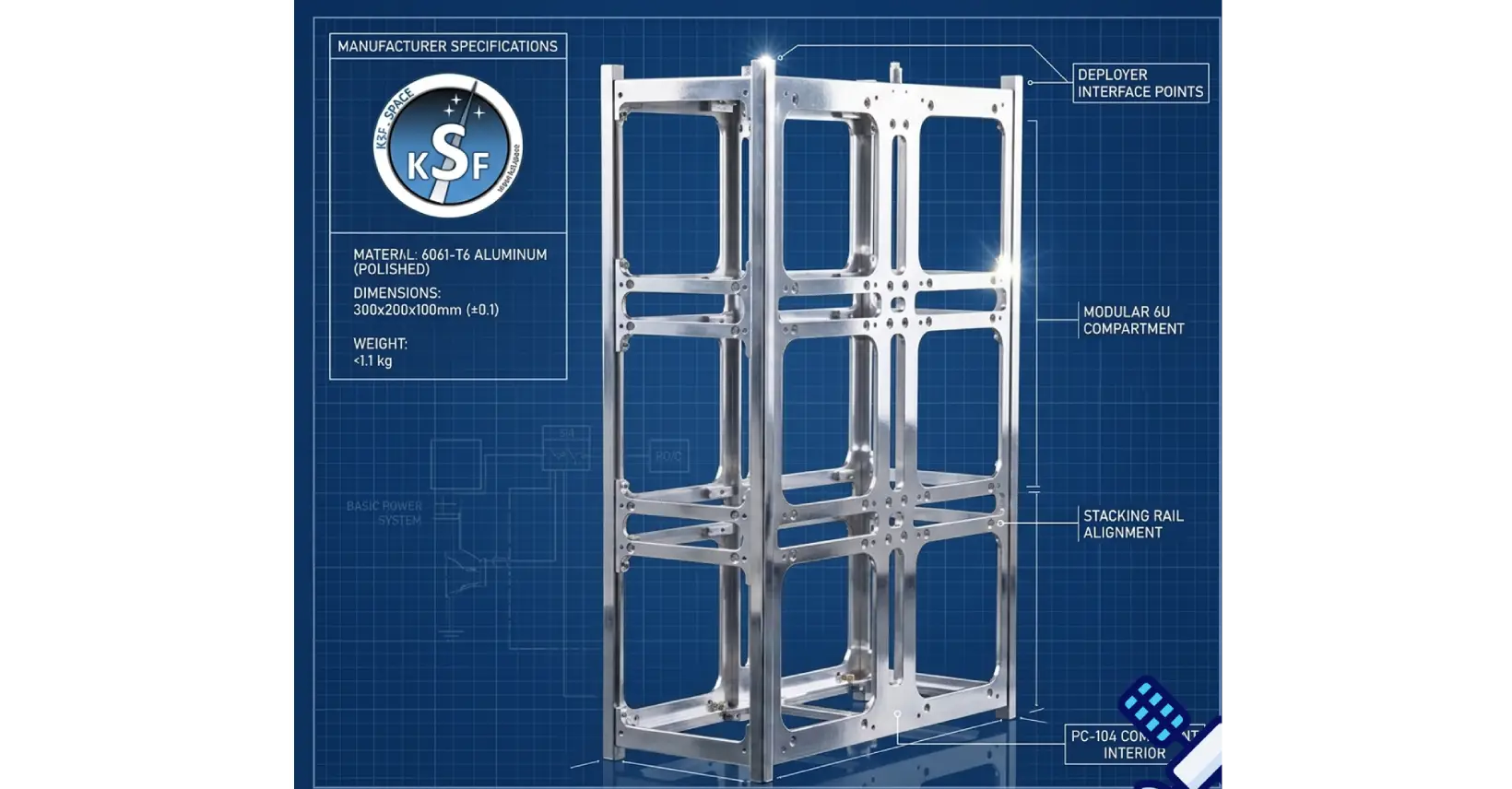
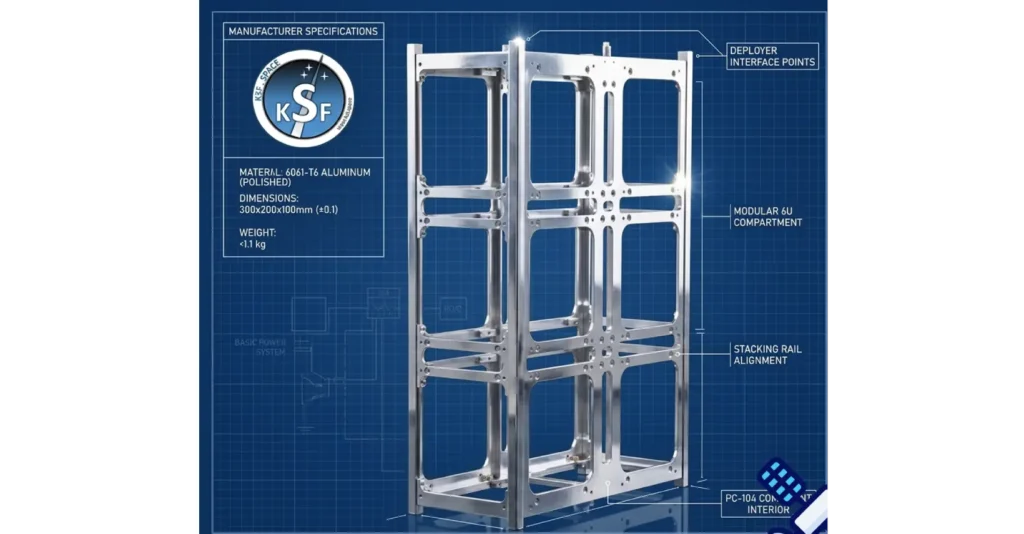
The KSF Space 6U CubeSat Structure frame chassis is fabricated utilizing precision-milled, aerospace-grade aluminum alloys (typically 6061-T6 or 7075-T6). This selection ensures an exceptional strength-to-weight ratio, allowing the dry mass of the primary chassis to remain well under 1.10 kg. By minimizing the structural mass budget, KSF Space enables satellite builders to maximize their allocated payload weight, directly enhancing the scientific or commercial value of the mission.
Modular Internal Architecture and PC104 Compliance
Time-to-Orbit (TTO) is a critical metric for commercial constellation developers. Delays in assembly, integration, and testing (AIT) can result in missed launch windows and increased capital burn rates.
To address this, the KSF Space 6U frame incorporates a highly adaptable, modular internal layout. Featuring standardized mounting points and full compatibility with the PC104 board standard, the interior allows for efficient component integration. Engineering teams can seamlessly stack:
- Electrical Power Systems (EPS): Battery management units and high-capacity lithium-ion cells.
- On-Board Computers (OBC): Redundant processing units designed for command, data handling, and autonomous orbital operations.
- Communication Subsystems: Transceivers and software-defined radios (SDRs) optimized for global ground station networking.
- Payload Modules: Custom customer-built sensor suites, optical apertures, or scientific payloads.
This plug-and-play approach permits subsystems to be easily swapped, tested, and reconfigured, significantly mitigating engineering risk during the integration phase.
Thermal Stability, Outgassing Mitigation, and Space Qualification
Managing Orbital Thermal Environments
As a satellite orbits the Earth, it transitions between direct solar radiation and the deep cold of the planet’s shadow every 45 minutes. This causes extreme thermal cycles ranging from approximately -50°C to over +100°C. Without robust thermal management, structural components can expand and contract unevenly, causing internal stress, optical misalignment, and mechanical failure.
The KSF Space 6U CubeSat Structure frame chassis is engineered with isotropic thermal expansion properties. The choice of aluminum alloys ensures rapid thermal dissipation across the entire chassis, eliminating dangerous localized hotspots. Additionally, surface treatments such as hard-anodizing provide enhanced radiation shielding and customized solar absorptance-to-emittance ratios.
Low-Outgassing Materials and Optical Protection
In the vacuum of space, industrial polymers, adhesives, and low-grade metals release volatile organic compounds (VOCs) through a process known as outgassing. These outgassed molecules tend to condense onto critical cold surfaces, coating optical lenses, obstructing Earth-observation cameras, and degrading the efficiency of solar panels.
Every component, surface coating, and fastener utilized within the KSF Space 6U cubesat structure adheres strictly to NASA and ESA low-outgassing standards (ASTM E595). By mandating a Total Mass Loss (TML) of less than 1% and a Collected Volatile Condensable Material (CVCM) of less than 0.1%, KSF Space ensures that high-value payload optics and sensitive instrumentation remain free from molecular contamination throughout the lifecycle of the spacecraft.
Commercial and Technical Advantages for Constellation Builders
Accelerating the Deployment of Global IoT Networks
The growth of the Internet of Things requires continuous, low-latency data relay capabilities over regions devoid of terrestrial cellular coverage—such as oceans, polar zones, and remote industrial corridors. Building a resilient network requires a constellation of interconnected satellites operating in coordinated orbital planes.
For constellation builders, capital expenditure (CapEx) tracking is critical. Selecting the KSF Space 6U frame cuts hardware acquisition costs for structural components by up to 70% compared to typical corporate vendors. This capital efficiency allows developers to reallocate financial resources toward advanced sensor development, expanded launch integration contracts, or robust ground station software infrastructure.
Standardized Deployment Mechanisms and Launch Vehicle Compatibility
A significant engineering asset of the KSF Space 6U nanosatellite design is its strict compliance with international CubeSat Design Specifications (CDS). The exterior chassis rails are precision-machined and hard-anodized to eliminate structural friction and cold-welding risks inside deployment mechanisms.
The structure is fully compatible with standard commercial deployment systems, including:
- CalPoly P-POD (Poly-PicoSatellite Orbital Deployer)
- Nanoracks CubeSat Deployers (NRCSD)
- Planetary Systems Corporation (PSC) Canisterized Satellite Dispensers
- Exolaunch EXOpod units
This universal compatibility ensures that satellite operators can secure launch slots on a wide variety of rideshare missions—whether utilizing a SpaceX Falcon 9, an Rocket Lab Electron, or an ISRO PSLV launcher—without modifying the primary structural design.
Environmental Testing and Flight Readiness Verification
Surviving the Launch Vehicle Environment
Before a satellite is integrated into a rocket’s deployer, launch providers require definitive proof that the vehicle will not suffer a catastrophic structural failure that could threaten the primary payload. KSF Space structures are designed to comfortably pass the stringent NASA-GSFC-STD-7000 General Environmental Verification Standard (GEVS).
To achieve flight-ready certification, prototype architectures undergo comprehensive environmental testing workflows:
- Random Vibration Testing: Simulates the acoustic energy and intense structural shaking experienced during the atmospheric ascent phase.
- Sinusoidal Vibration Testing: Replicates the low-frequency mechanical inputs generated by liquid and solid-fuel rocket engines.
- Mechanical Shock Verification: Ensures the structural integrity of internal electronics mounts during separation events and pyrotechnic deployment shocks.
- Thermal Vacuum (TVAC) Simulation: Subjecting the fully integrated chassis to orbital pressures ($< 10^{-5}$ Torr) and temperature extremes to verify structural stability and material endurance.
Democratizing Space: The Delaware Non-Profit Model
Shifting the Economics of the NewSpace Economy
Why is KSF Space capable of offering a flight-qualified, highly durable 6U CubeSat Structure frame chassis for only $4,800, while commercial competitors routinely charge upwards of $15,000 for equivalent hardware? The answer lies in the fundamental organizational architecture of the entity.
As a US-registered non-profit organization operating out of Delaware, KSF Space is not driven by venture capital expectations or commercial profit margins. Instead, the foundation’s core charter centers on the global democratization of space technology. By focusing on manufacturing optimization, leveraging advanced industrial additive manufacturing alongside CNC machining, and operating with a lean institutional structure, KSF Space passes direct material savings down to the end-user.
Supporting Academic Research and Emerging Space Nations
By lowering the entry cost for high-quality space hardware, KSF Space has transformed the educational landscape. Universities, small research labs, and emerging nations that were previously priced out of practical aerospace operations can now fund real-world orbital missions.
This empowers students and researchers to shift from purely theoretical satellite design exercises to physical, hands-on assembly, integration, testing, and deployment operations. The financial efficiency achieved through this model acts as a catalyst for grass-roots innovation, training the next generation of space engineers without exhausting academic budgets.
Step-by-Step Satellite Integration Guide with KSF Space
Building a functional 6U satellite requires a methodical approach to subsystem organization. The internal adaptability of the KSF Space chassis streamlines this progression from a blueprint to a flight-certified asset.
Phase 1: Mission and Payload Definition
Before securing hardware, engineering teams must precisely outline the mission’s operational constraints. Defining parameters like payload mass, required input voltage, thermal dissipation metrics, and data link budgets dictates whether a 6U form factor is ideal or if larger configurations (such as 12U or 16U) are required.
Phase 2: Ordering and Custom Modification
Satellite builders can coordinate with KSF Space via their official portal at www.ksf.space to review standard configurations. Unlike rigid corporate assembly lines, KSF Space provides accessible options for customized external panel machining. If a mission requires a specific cutout for a camera lens, an optical star tracker, or a deployable antenna array, these modifications can be integrated directly during production.
Phase 3: Subsystem Stacking and Integration
Once the 6U CubeSat Structure frame chassis arrives, the hardware stacking process begins. Technicians install the PC104 internal rails, securing the Electrical Power System (EPS), the battery packs, the On-Board Computer (OBC), and the communications payload. Internal cable runs are carefully organized to avoid electromagnetic interference (EMI) and to maintain the satellite’s balance.
Phase 4: Environmental Testing and Verification
The fully integrated satellite is subjected to localized vibration and thermal vacuum testing to confirm it meets launch vehicle integration requirements. Passing these gates ensures that the spacecraft will function reliably upon deployment into LEO.
Conclusion: Securing Your Orbit with KSF Space
The future of orbital infrastructure belongs to agile, cost-effective, and highly scalable technology architectures. Whether you are an aerospace engineer developing an experimental Earth-observation instrument, a commercial entrepreneur deploying a 50-satellite IoT constellation, or a university researcher pushing the boundaries of miniaturized science, structural costs should not be the barrier that keeps your technology grounded.
The KSF Space 6U CubeSat Structure frame chassis provides the perfect confluence of professional-grade reliability, international launch compatibility, and an unmatched $4,800 non-profit price point. By investing in a platform that prioritizes space accessibility over corporate profit margins, satellite builders can optimize their development pipelines, de-risk integration workflows, and allocate their capital where it matters most: the payload.
To secure a formal quote, review technical drawings, or discuss custom machining options for your upcoming orbital campaign, visit the official KSF Space foundation portal today at www.ksf.space or contact their global mission support desk at [email protected].
Frequently Asked Questions (FAQ)
What is the exact price of the KSF Space 6U CubeSat structure, and why is it so affordable?
The KSF Space 6U structure is priced at a fixed $4,800 USD. It achieves this affordability because KSF Space operates as a US-registered non-profit organization in Delaware rather than a commercial vendor. The foundation’s primary charter is to democratize space exploration, enabling them to supply flight-certified hardware at near-cost prices by bypassing standard corporate margins.
Is this 6U chassis compatible with major commercial launch vehicles like SpaceX?
Yes. The structure is precision-machined to conform to the official international CubeSat Design Specification (CDS). It is fully compatible with standard canisterized deployment mechanisms, such as P-POD, Nanoracks, and Exolaunch systems. This ensures seamless integration onto major commercial and institutional launch vehicles globally.
Can KSF Space customize the external panels for specialized payloads?
Yes, KSF Space offers flexible customization options. During the ordering process, engineering teams can provide custom technical schematics detailing required modifications, such as specific panel cutouts for camera lenses, star trackers, optical sensors, or custom deployable antenna ports.
What materials are used to construct the primary chassis frame?
The primary structural frame is fabricated from high-strength, aerospace-grade aluminum alloys (6061-T6 or 7075-T6). This material configuration ensures excellent mechanical stability under launch loads, high isotropic thermal conductivity to mitigate orbital hot spots, and minimal dry mass.
Does the structure meet NASA outgassing requirements for sensitive optics?
Yes. All materials, surface treatments, and anodizing processes utilized by KSF Space satisfy the standard ASTM E595 low-outgassing test specifications. This limits Total Mass Loss (TML) to less than 1% and Collected Volatile Condensable Material (CVCM) to less than 0.1%, protecting onboard optical instruments and solar arrays from molecular deposition.
References
- CubeSat Design Specification (CDS) – California Polytechnic State University. The industry standard defining structural dimensions, tolerances, and deployment constraints for nanosatellites.
- NASA-GSFC-STD-7000 (GEVS) – General Environmental Verification Standard. The reference protocol for structural vibration, acoustic, and thermal vacuum testing of space flight hardware.
- ASTM E595 – Standard Test Method for Total Mass Loss and Collected Volatile Condensable Materials from Outgassing in a Vacuum Environment. The core material science standard protecting payload optics from contamination.
- KSF Space Foundation Technical Documents Repository (2026). Internal engineering specifications, structural material test records, and global pricing documentation for modular CubeSat architectures (1U to 24U). Available via official channels at www.ksf.space.